Is it a powerful force that puts you under a freaky spell where you have no control over your actions?
Is it a mysterious energy that elevates your brain to a higher plane of existence?
While the concept of hypnotic trance certainly conjures up a lot of intrigue and curiosity, the truth is a lot simpler.
In fact, significantly so.
"Trance" really is just a metaphor.
Yep, really.
We hope that this discovery didn’t just blow the air out of your tires in the same way that Dorothy’s first meeting with the Wizard of Oz did.
So let us explain...
Hypnotic "trance" is just a word that we use to identify the conditions under which someone responds to hypnotic suggestions.
We understand that this might read as a bit of a surprise to you. But the proof really is in the pudding. Academics have been studying trance for over a century now, trying to pinpoint exactly what it is.
Is it a state? Is it a trait? Is it a genetic predisposition?
But no matter how hard they look, they can’t find an answer.
They’ve even used fMRI scans that measure brain activity. But they found there was no detectable pattern in the brain when someone was in a trance.
However, thankfully there’s a very good reason they came to this simple, yet obvious conclusion:
We’re in the trance state so often that it doesn’t show up in the brain as anything unusual. It’s an experience that occurs in everyone on a regular basis.
And to further compound this discovery, here is another little known fact:
You don’t need to be in a trance for hypnosis to occur. Hypnosis and trance are not synonymous.
Or otherwise put: being in a trance is not proof that any hypnotic experience is taking place.
However, what does go together like two peas in a pod is hypnosis and suggestion.
If you give someone a suggestion and they act on it, then it’s your gold litmus test that hypnosis is indeed working, meaning that hypnosis and suggestion are completely synonymous with one another.
After reading the above, understandably, you might be wondering, what’s the point of trance then?
So, let us explain...
Trance serves as a type of shorthand to let you know that the conditions in which someone responds to hypnotic suggestions are right.
Therefore, being able to identify a trance or the signs of trance can help you know when a hypnotic relationship has been established.
It gives you a green light to proceed with whatever hypnosis work you intend on doing.
That it’s an optimal time to cue up your suggestions.
Meaning that trance plays an incredibly important role in the whole hypnosis process.
In this article, we’re going to explain what this role is, in addition to explaining the following essential concepts so you’re able to confidently put your subjects into a trance...
To pay tribute to an American great, each January a federal holiday is celebrated in the name of Martin Luther King, Jr.
So while this article is part homage to this holiday, it is also to recognize the powerful hypnotic techniques that were at play in MLK’s history-changing speech, "I Have A Dream."
And while MLK may not have knowingly used hypnotic language, it’s clear from this speech that he had a keen understanding of the persuasive power of words.
If you haven’t had the opportunity to watch it before, you can check it out here:
The whole point behind hypnosis and hypnotic language can be summed up using the ABS formula, which is:
A - absorb attention
B - bypass the critical factor
S - stimulate the unconscious mind
Regular readers will already be familiar with this formula, so here’s a quick recap of how it works.
In order to be able to hypnotize someone, you need to get their attention. If you can’t get their attention, then they won’t be listening to what you have to say.
And unless they’re listening, you won’t be able to communicate with them on any level. One sure-fire way to get their attention is through the use of hypnotic language.
Once you’ve got their attention, your next task is to bypass their critical mind. That’s the part of the conscious mind that’s always criticizing, analyzing, and rejecting information.
It thinks logically and rationally, blocking messages so they can’t make their way into the unconscious mind, the place where creativity, imagination, inspiration, motivation and insight reside.
Hypnotic phrases, themes and power words are the perfect tools to access it.
As soon as that part of the conscious, critical mind is bypassed, you’re able to start communicating directly with the unconscious.
You might recognize this as the process that takes someone into a hypnotic trance, to a stage where it’s possible to make suggestions that will lead their thinking and future actions in a particular direction.
You can achieve this by making good use of hypnotic themes.
Clearly, Martin Luther King, Jr. wasn’t trying to hypnotize his audience in the strict sense of the word. And yet, much of this famous speech has a great deal of hypnotic power.
Let’s take a closer look at the speech and see if we can identify some of the techniques found within it.
Hidden Hypnotic Techniques In The "I Have A Dream" Speech
1. Hypnotic Themes
Looking at the speech as a whole, you can see that there are a number of hypnotic themes that permeate it.
A hypnotic theme is simply an idea, like relaxation, comfort, potential, success, and so on. In the context of this speech, the themes that run through it include the notions of freedom, independence, unity, equality and justice.
That makes absolute sense, since MLK gave the speech exactly 100 years after Lincoln signed the Emancipation Proclamation.
The theme of freedom begins on the very first line.
The word "freedom" is repeated no less than twenty times in total, with the shorter version "free" appearing an additional five times.
That’s what you’d expect in a speech designed to help put an end to segregation and inequality.
Ironically, the word independence only shows up once in a reference to the Declaration of Independence.
Naturally, though, if someone has their freedom, that implies they’ve also got their independence. So the theme of independence is present even if not stated outright.
What’s the most universal sign of unity?
The act of joining hands.
To make this even more poignant, the text refers to boys and girls from both ethnic backgrounds joining hands "as sisters and brothers."
The speech concludes with another reference to the act of joining hands, this time stating that "all of God’s children, black men and white men, Jews and gentiles, Protestants and Catholics, will be able to join hands and sing" - showing clearly the need to put aside our differences and start treating each other as equal human beings.
Where equality and justice are concerned, King uses a number of techniques to drive these themes home. He quotes the famous line from the Declaration of Independence that "all men are created equal." The word "justice" appears in the speech eight times, making listeners aware of two important facts:
That all Americans, regardless of the color of their skin, are entitled to the same privileges and considerations
That black Americans have been waiting patiently for their "justice" for 100 years
2. Metaphors
This speech is nothing short of a master class in the use of metaphor.
King paints pictures with words as skillfully as if he’d been given a paintbrush and every shade of pigment under the sun.
There are so many examples, in fact, that there isn’t room in this article to discuss every one of them.
Instead, here’s a list of some of the most potent and descriptive metaphors that still resonate with anyone who listens to the speech:
Seared in the flames of withering injustice
Crippled by the manacles of segregation and the chains of discrimination
A lonely island of poverty in the midst of a vast ocean of material prosperity
Rise from the dark and desolate valley of segregation to the sunlit path of racial justice
From the quicksands of racial injustice to the solid rock of brotherhood
The sweltering summer of the Negro’s legitimate discontent - (note the allusion and comparison to Shakespeare’s speech from Richard III, "now is the winter of our discontent")
Drinking from the cup of bitterness and hatred
Until justice rolls down like waters and righteousness like a mighty stream - (a couple of similes, but equally as provocative)
Hew out of the mountain of despair a stone of hope
Transform the jangling discords of our nation into a beautiful symphony of brotherhood
You’ll also notice how some of these metaphors do more than paint pictures: they also make a stark contrast between two extremes, such as the stone of hope versus the mountain of despair.
3. Anaphora
In case you haven’t heard of it before, anaphora is a rhetorical term that refers to the repetition of words at the beginning (and sometimes the end) of phrases.
The most often quoted example of this is the phrase "I have a dream" which appears eight times in successive sentences.
Other uses of the device include the following:
One hundred years later
Now is the time
We can never (cannot) be satisfied
Let freedom ring
As you probably realize, repetition is a useful tool that helps activate the hypnotic state.
It can have the same effect as a mother gently sending her child to sleep with the back and forth movement of a rocking chair.
In the hands of a great speech writer, the repetition of key phrases helps bury significant ideas into the minds of listeners, making sure they take away as much of the message as possible.
4. Power Words
We’ve seen how the speech makes extensive use of metaphors to implant pictures into the unconscious mind.
Not close-ups, but vast landscapes needed to embrace those large universal themes mentioned earlier.
You may have heard of power words.
They’re words such as: and, because, as well as, imagine, and remember.
These are simple words that get repeated to help you create your own pattern of hypnotic language.
What you may not be so familiar with is the Hypnotic Language Shortcut System (or HLSS).
The HLSS is a collection of cards with 70 power words organized into a number of different suits and categories.
The cards are colored according to their designation, so that RED suit stands for imagination, GREEN suit for linkage, ORANGE suit for need, and so on.
On one side of the card you’ll find the power word (such as imagine) while on the other side you’ll find several sentences giving examples of how to use the word in a hypnotic language context.
Let’s get back to the ABS formula.
Each of the categories contained within the HLSS cards is designed to address one of the 3 parts of the formula, i.e. to absorb attention,bypass the critical factor, or stimulate the unconscious mind.
The question is, how do those criteria apply to one of the most famous speeches in history?
To find out, we’ll see if we can match up elements of the speech to the various HLSS categories, in an effort to discover which power words MLK made use of.
Read on to know more about the hypnotic power words and how they can influence people, like, MLK's speech on "I have a Dream" Visit here »
If you ever wanted to know how to make your hypnotic language more convincing, more persuasive, and more inspiring, you could do a lot worse than to study this speech.
You might even benefit from reading it out loud a few times. More than 50 years after it was written and delivered, its message is just as stirring, evocative, motivational and hypnotic as ever.
And if you’d like to learn more about hypnotic language - and perfect some of the techniques MLK used in his famous speech - we’re giving away copies of the Hypnotic Language Shortcut System for free, so get yours here.
Getting quizzed by people who are either simply curious or downright skeptical is one thing, but hypnotists have another issue to contend with. Especially when they’re starting out.
It’s natural in any profession to have doubts and reservations about your skills. As a hypnotist, you might worry about things such as:
What happens when someone keeps coming out of trance?
Am I skilled enough to actually help others?
If any of these questions or fears rings a bell with you, read through the hypnosis comics below for a light-hearted look at some of the main issues. And some suggestions on how to deal with them.
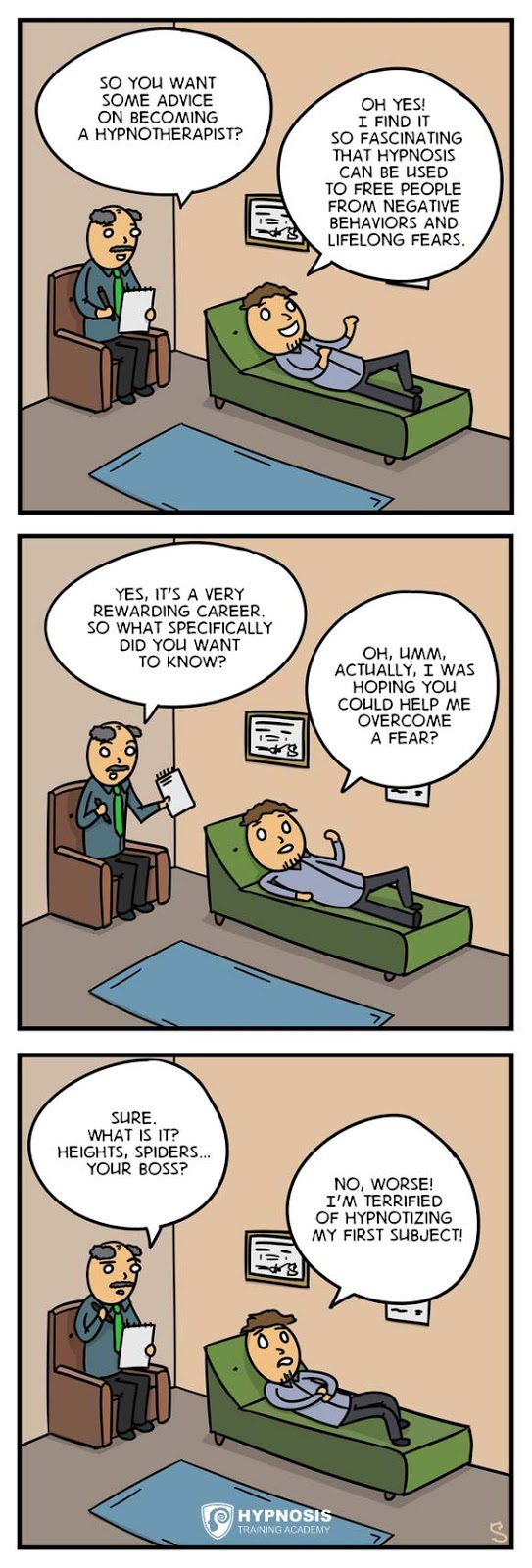
Yikes! What if you can’t hypnotize your first client? What if your mouth dries up, or you can’t get the words out? What if you get nervous and forget everything you’re supposed to know?
There’s always a first time. The trick is not to be too hard on yourself. You can’t expect to be a master at hypnosis without lots of experience behind you.
Like any other skill, the secret is really quite simple. Practice, practice, and then practice some more. If you try and you fail, then you just keep on trying. Failure is only another word for learning.
Sooner or later everything will fall into place and you’ll do it. And then you’ll feel amazing.
2. The "Skeptics" Favorite Question: Isn’t Hypnosis Just A Form Of Mind Control?
Look into my eyes...
Wouldn’t it be great if you could just say those words and put people under your spell? But you can’t, because in real life people have their own minds and their own freedom of choice.
Hypnosis has nothing to do with mind control.
That’s an image portrayed by Hollywood B-movies, just like the story of Dracula. But surely there aren’t many people who believe there are vampires walking amongst us.
To deal with doubters and skeptics, be prepared. Tell them exactly what hypnosis is and what it does. It’s just a form of focused relaxation that lets you turn your attention toward a single thought or idea. A way to shut out the outside world so you can deal with an issue quickly and effectively.
When people go for a massage, they don’t expect the masseur to rub their skin off as part of the process. They know the trained technician will help relax their muscles, reduce their stress and improve their circulation. Not because they have magic power in their fingers, but because they know what they’re doing. Read More »
To learn more about how to overcome the common hypnosis obstacles that a hypnotist faces, please visit Hypnosis Training Academy