Showing posts with label hypnotic trance. Show all posts

Tuesday, October 24, 2017

[Hypnosis Demonstration] How To Bypass The Critical Factor & Put A Resistant Subject Into A Hypnotic Trance

How To seamlessly break down someone's resistance during hypnosis with the Non-Awareness Set

As a hypnotist, you might already know lots of techniques you can use to break down someone's resistance.

But, they take time. Ideally, you need something that is fast, reliable, effective and easy to use. Something that fits into the 4-stage hypnosis protocol like a glove.

Something like the Non-Awareness Set. Interested in watching a breakdown of this technique?

Watch this hypnosis demonstration at HypnosisTrainingAcademy.com to see master hypnotist Karsten Küstner put a resistant subject into a hypnotic trance using the Non-Awareness Set.

Monday, September 25, 2017

How To Master Hypnotic Influence: Here’s How To Create Powerful Channels In The Mind Using Emotion, Logic and Reasoning Share

How to master hypnotic influence & create channels in the mind

Interested in discovering how to master hypnotic influence and create powerful channels in the mind using emotion, logic and reasoning?

Yes? Well we have got good news for you as Hypnosis Training Academy has created an in-depth guide that explains the heart of influence, the Influence Strategy Tree and the 5 branches of influence that fall under it.

With this guide, you will get a very clear sense of how you can effectively use hypnosis to carve influence channels in people’s mind.

This 2-part guide on hypnotic influence also takes you through strategic influence techniques to generate a positive change in your subjects and clients….

  1. ABS formula
  2. The Heart of Influence
  3. The Influence Strategy Tree
  4. The 5 Influence Strategy Tree Choices

Curious to discover more about them in detail? Check out the latest article on HypnosisTrainingAcademy.com now and understand what is the role of influence when used in hypnosis….

Saturday, September 16, 2017

Breakthrough Stanford Study Reveals What Hypnotists Have Long Known – Hypnotic Trance Changes Brain Patterns & Activity

Breakthrough Research: Brain Activity and Hypnotic Trance
 It’s the 21st century.

Every other day, there’s news of some fascinating discovery…

Brain implants to reverse paralysis.

Vehicles that can drive themselves.

Facial recognition software for ID confirmation.

It seems like you can’t open a newspaper or browse a news channel without hearing of yet another remarkable breakthrough.

Which is why we were excited about this hypnosis discovery making it into the limelight…

You see, it’s no secret that academics have studied hypnosis and trance phenomena for more than a century.

But despite their best efforts, they were unable figure out what trance was. Was it a state? Was it a trait? Was it a genetic predisposition?

No matter how hard they tried, they couldn’t find an answer. Even with fMRI scanners that measure brain activity.

In fact, scientists concluded that there was no detectable pattern in the brain when someone was in a hypnotic trance.

That was until new research carried out by a team working under the legendary Dr. David Spiegel at the Stanford University School of Medicine got to work to set the record straight.

They published the results of their study in the journal Cerebral Cortex – causing quite the buzz in the hypnosis world because they confirmed what hypnotists have long suspected…

But before we reveal the details of this breakthrough study, let’s take a quick look at Spiegel’s background.

The Son Of A Clinical Hypnosis Expert

David Spiegel, M.D., is professor and associate chair of psychiatry and behavioral sciences at Stanford University.

He’s one of America’s most respected experts in the clinical uses of hypnosis and is the son of the late Herbert Spiegel, M.D., who was also an expert in hypnosis.
Spiegel’s research has frequently focused on two elements: cancer and hypnosis. Back in 1983 he did a study looking at in breast cancer patients using hypnosis.

He found that self-hypnosis exercises as part of a group therapy experience had: “A direct effect in altering the patient’s perception of pain.”

His associations with hypnosis go back even further than that. In 1972, Spiegel underwent shoulder surgery. Following the 3-hour operation, he refused any painkilling medication.

Instead, Spiegel used self-hypnosis to control the pain. Given that he had an incision running from the top to bottom of his shoulder, it’s a safe bet that the pain was considerable.

In addition to his work with cancer, Spiegel has studied how hypnosis can be used in other applications.

These include:

Dr.Spiegel hypnosis research findings

 Dr. Spiegel’s links with hypnosis and his credibility are beyond question. However, just like everybody else working in the field, there was still something major he wanted to prove…

He knew what hypnosis was capable of doing, but there was something else he wanted to uncover.

Since hypnosis was a change of state, there must also be some type of change in the brain. And there must be a way of seeing this change too.

In 2016, Spiegel and a team of researchers decided to prove their suspicions.

Spiegel’s Study: Brain Activity And Functional Connectivity Associated With Hypnosis

The purpose of the study was to try to identify changes in brain activity during the hypnotic state.

Through this study, Spiegel and his colleagues discovered that some parts of the brain function differently under hypnosis than during normal consciousness.
They also identified brain areas altered during hypnotic trances.

These findings might help explain the intense absorption, lack of self-consciousness and suggestibility that characterize the hypnotic state.

If you’d like to discover more about Dr. David Spiegel hypnosis research findings and how you can use it to control pain and increase someone’s self-esteem? Check out the latest article on HypnosisTrainingAcademy.com now…..

Monday, July 17, 2017

What Can Hypnosis Treat? 15 Common Issues Resolved By Going Into A Hypnotic Trance (PLUS Scientific Studies To Back It Up)

As a hypnotist, there are some questions you get asked all the time.

  
https://hypnosistrainingacademy.com/what-hypnosis-can-treat/?utm_campaign=linkb&utm_medium=article-to-bp&utm_source=hta-blogspot&utm_term=CT


“How does hypnosis work?”  

“Will I lose control?”  

“What can hypnosis treat?”

People are often surprised by the responses to all of these questions, but the last question in particular never fails to impress people.

Why?

Because hypnosis can treat everything from helping people stop smoking (smoking cessation), weight loss, sexual dysfunction, depression, anxiety, pain relief, self-esteem issues, physical healing, trauma, bad habits and phobias, in addition to many other issues.

In fact, you might be hard pressed to discover something that hypnosis WON’T be able to treat.

But why is this the case? What makes hypnosis so special, and why can it treat so many different issues?  

To understand this, check out this article at HypnosisTrainingAcademy.com now
 

Monday, July 4, 2016

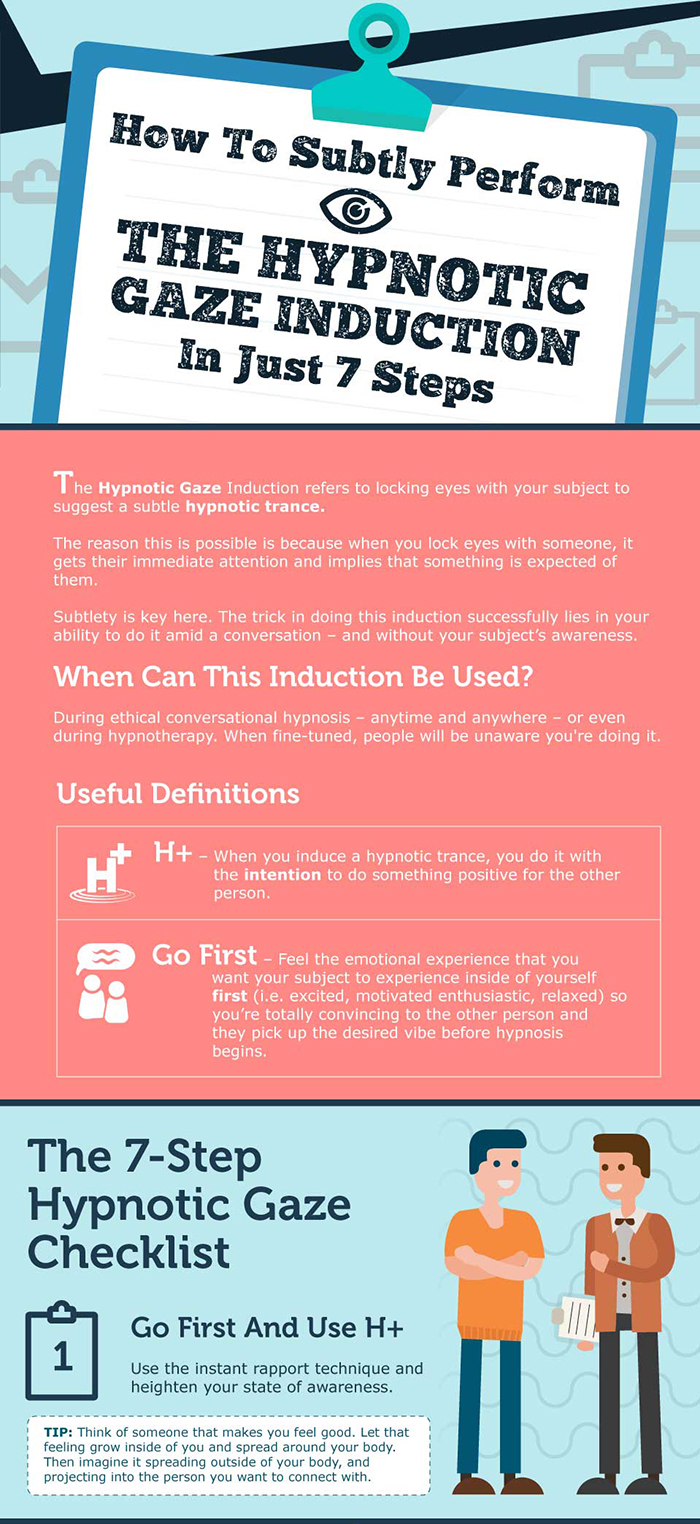
How To Subtly Perform The Hypnotic Gaze Induction In Just 7 Steps

How to perform the hypnotic gaze induction

As the art of hypnosis is a subtle, skillful practice that involves specific language, body language and unconscious sub-communication, the skilled hypnotist has many hypnosis techniques up their proverbial sleeves.

...the hypnotic gaze induction being one of them.

And as this type of hypnotic induction can be used in any situation, it's incredibly useful (not to mention, kinda cool) – meaning becoming well-versed in its finer intricacies is well worth your while.