Showing posts with label anxiety. Show all posts

Saturday, September 16, 2017

Breakthrough Stanford Study Reveals What Hypnotists Have Long Known – Hypnotic Trance Changes Brain Patterns & Activity

Breakthrough Research: Brain Activity and Hypnotic Trance
 It’s the 21st century.

Every other day, there’s news of some fascinating discovery…

Brain implants to reverse paralysis.

Vehicles that can drive themselves.

Facial recognition software for ID confirmation.

It seems like you can’t open a newspaper or browse a news channel without hearing of yet another remarkable breakthrough.

Which is why we were excited about this hypnosis discovery making it into the limelight…

You see, it’s no secret that academics have studied hypnosis and trance phenomena for more than a century.

But despite their best efforts, they were unable figure out what trance was. Was it a state? Was it a trait? Was it a genetic predisposition?

No matter how hard they tried, they couldn’t find an answer. Even with fMRI scanners that measure brain activity.

In fact, scientists concluded that there was no detectable pattern in the brain when someone was in a hypnotic trance.

That was until new research carried out by a team working under the legendary Dr. David Spiegel at the Stanford University School of Medicine got to work to set the record straight.

They published the results of their study in the journal Cerebral Cortex – causing quite the buzz in the hypnosis world because they confirmed what hypnotists have long suspected…

But before we reveal the details of this breakthrough study, let’s take a quick look at Spiegel’s background.

The Son Of A Clinical Hypnosis Expert

David Spiegel, M.D., is professor and associate chair of psychiatry and behavioral sciences at Stanford University.

He’s one of America’s most respected experts in the clinical uses of hypnosis and is the son of the late Herbert Spiegel, M.D., who was also an expert in hypnosis.
Spiegel’s research has frequently focused on two elements: cancer and hypnosis. Back in 1983 he did a study looking at in breast cancer patients using hypnosis.

He found that self-hypnosis exercises as part of a group therapy experience had: “A direct effect in altering the patient’s perception of pain.”

His associations with hypnosis go back even further than that. In 1972, Spiegel underwent shoulder surgery. Following the 3-hour operation, he refused any painkilling medication.

Instead, Spiegel used self-hypnosis to control the pain. Given that he had an incision running from the top to bottom of his shoulder, it’s a safe bet that the pain was considerable.

In addition to his work with cancer, Spiegel has studied how hypnosis can be used in other applications.

These include:

Dr.Spiegel hypnosis research findings

 Dr. Spiegel’s links with hypnosis and his credibility are beyond question. However, just like everybody else working in the field, there was still something major he wanted to prove…

He knew what hypnosis was capable of doing, but there was something else he wanted to uncover.

Since hypnosis was a change of state, there must also be some type of change in the brain. And there must be a way of seeing this change too.

In 2016, Spiegel and a team of researchers decided to prove their suspicions.

Spiegel’s Study: Brain Activity And Functional Connectivity Associated With Hypnosis

The purpose of the study was to try to identify changes in brain activity during the hypnotic state.

Through this study, Spiegel and his colleagues discovered that some parts of the brain function differently under hypnosis than during normal consciousness.
They also identified brain areas altered during hypnotic trances.

These findings might help explain the intense absorption, lack of self-consciousness and suggestibility that characterize the hypnotic state.

If you’d like to discover more about Dr. David Spiegel hypnosis research findings and how you can use it to control pain and increase someone’s self-esteem? Check out the latest article on HypnosisTrainingAcademy.com now…..

Wednesday, June 28, 2017

How Hypnosis Is Used For Anxiety And Depression: An Important Guide For Hypnotists PLUS 3 Scientific Studies That Explain Why it Works

How Hypnosis Is Used For Anxiety And Depression: An Important Guide For Hypnotists PLUS 3 Scientific Studies That Explain Why it Works

"How can hypnosis help with anxiety and depression?"

This is a common (and fantastic) question.

Which is why we've done our best to explain the answer as clearly as possible so you're able to do the same with your hypnosis subjects.

Reason being, while a lot of hypnotists know that hypnosis can help with anxiety and depression, they might not always be able to clearly articulate the ins and outs of how hypnosis helps treat mental illnesses such as anxiety and depression.

So this article will equip you with the knowledge to do just that.

How Is Hypnosis Used For Anxiety And Depression And What Does It Have That Most Modern-Day Therapies Lack?

There is one key difference between hypnosis and most modern-day therapies that don't stack up.

Any idea what this is? We'll reveal what it is in a minute.

But first, it's important to explain how hypnosis gives you direct access to the playground of your mind - the unconscious.

This is where your "true identity" lies. Everything and anything that makes up who you are resides in your unconscious.

So the way hypnosis helps you access your mental "playground" is the way it engages your conscious mind.

Or otherwise put, imagine that there was a gatekeeper that kept you from peeking into your unconscious mind's files and databases making sure you didn't meddle too much.

Well hypnosis engages and schmoozes this gatekeeper. And once the gatekeeper is occupied, a hypnotist is able to really examine the underpinnings of your unconscious.

So hypnosis and trance simply open up the doorway. They allow you to fully imagine (often in vivid technicolor detail) how much better life can be. What it would be like to take on completely new behaviors, beliefs and identities.

Given this, the one thing hypnosis has that most modern day therapies lack is the ability to quiet your negative internal conversations.

Have you ever wondered about some positive change you'd like to make, only to have that rational mind of yours pop up and tell you why you can't have it?

That's the negative internal dialogue that most therapies can't seem to sneak around. Hypnosis does an incredible job of sidestepping this.

Another thing that sets hypnosis apart is the ability to restructure cognitive distortions.

Hypnosis allows for the accessing and restructuring (changing the pattern) of conscious, automatic and unconscious cognitive distortions and negative self-schema.

(Psst! In case, you're wondering what the last term refers to - self-schema - it's your long-lasting and stable set of memories that summarizes your beliefs, experiences and generalizations about yourself in specific behavioral domains).

And it just so happens that hypnosis is naturally adept at altering the self-schema.

Your job as the hypnotist is to identify the thought patterns that have been causing your clients harm and then help them re-write these mental stories.

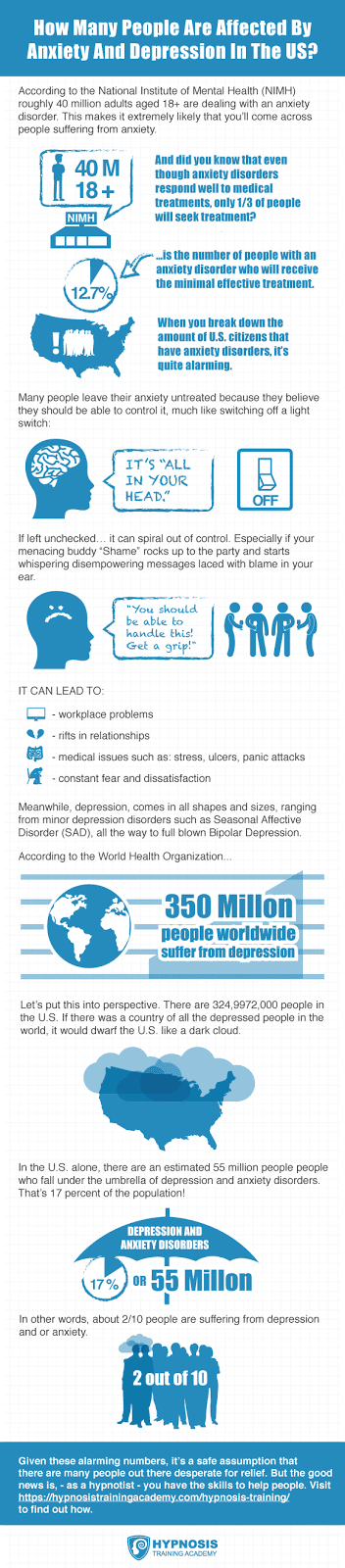
So now that you know more about how hypnosis is used for anxiety and depression, let's take a closer look at the mental health epidemic sweeping across the U.S. (and much of the globe).

How many people have depression anxiety disorders infographic
Research has shown that hypnosis is highly-effective at dealing with anxiety and depression, and what’s more, is that positive results can often be seen in a fraction of the time.

The other benefit with hypnosis is that it’s 100% natural and drug-free – which is also good news given how quick doctors can be to prescribe medication.

Curious to discover more about how hypnosis can be used as a powerful ally in the emotional struggles that haunt depression and anxiety sufferers?

Check out this article to discover why hypnosis works, the techniques you can use to treat it, in addition to 3 scientific studies that back its effectiveness up.