Friday, September 16, 2016

[ADVANCED GUIDE] How To Master Hypnotic Regression Therapy – Part II: Proven 12 Step Method To Successfully Dissolve Anxiety, Phobias and Traumas, Plus Bonus Video Training

Master Regression Therapy – 12 Step Method To Successfully Dissolve Anxiety, Phobias and Traumas
Welcome to Part 2 of our comprehensive guide on regression hypnotherapy.

In this article, the 12-step regression method, which is taught worldwide at our hypnosis training seminars, will be broken down step-by-step.

After the technique breakdown, we’ve included a real-life demonstration of master hypnotist Igor Ledochowski doing regression therapy (using this exact method) to remove a woman’s fear of snakes, which had been terrifying her for 30 years.

Then, we’ll show you how to put the same technique into practice again – except this time conversationally – and in just a few minutes, too.

If, however, you’ve landed on this page having bypassed the essential principles and best practices covered in Part 1, we do urge you to take a step back and read the first article in this 2-part series.

Reason being: regression therapy is a very big topic. One where you’re dealing with someone’s (often intense) emotions and the way that person make sense of the world.

Therefore, this 12-step method will only be effective once you have an understanding of the dynamics behind regression therapy, which is covered in Part 1.

If, however you’re ready to proceed…

A FEW FINAL NOTES:

  • In the below example, the client is often referred to as the “adult” and “child.” This is based on the assumption that the memory or emotional trauma you’re trying to dissolve happened in their childhood (so you’re bouncing back and forth between adulthood and childhood), however, of course this may not be always the case.
  • As you work through each of the steps, which can be done very quickly once you become familiar with them, it’s important to continually give praise and encouragement to your client. Tell them they’re doing great, build up their self-confidence, comment on how well they’re handling it, and generally keep boosting their self-belief at every opportunity you get!
And for ease of use when reading this article, the links from each section are below:

  • The 12 Steps Of Regression Therapy

Do you want to become an Elite-Level Hypnotist? Join Igor’s upcoming webinar to find out what his 5 keys to success are and how to use them in your practice.
 

Wednesday, September 14, 2016

[ADVANCED GUIDE] How To Master Hypnotic Regression Therapy – Part I: Essential Principles To Profoundly Transform Your Subject’s Emotional Trauma

How To Master Hypnotic Regression Therapy - Part I

Warning! This 2-part series on regression hypnotherapy contains intermediate to advanced content that will make you a powerful force for good Hypnosis Power in the world.

So if you’re looking to for a comprehensive guide on regression hypnotherapy to enhance your existing hypnosis knowledge, you’ve come to the right place.

For ease of use, this guide is divided into two parts.

Part 1 dives straight into the essential principles and best practices that you need to be aware of before doing any regression work.

And in Part 2 the 12-step regression hypnotherapy method, which is taught by the Hypnosis Training Academy, is broken down, step-by-step.

And to show you how to piece it all together, in Part 2 there is also a bonus training video of master hypnotist Igor Ledochowski performing this powerful regression hypnotherapy method on a woman with a serious snake phobia.

To view the individual sections of Part 1, click on the links below (or continue reading):
And once you’ve gone through the essential principles covered in this article, you can access Part 2 here: [ADVANCED GUIDE] How To Master Hypnotic Regression Therapy – Part II: Proven 12 Step Method To Successfully Dissolve Anxiety, Phobias and Traumas, Plus Bonus Video Training

But first…

Before You Get Started…

Regression is a huge topic.

Given this, it’s impossible to condense all of the relevant information into the space of two articles.

This is why we’ll be focusing on the main underlying principles so you can use this information to enhance your existing knowledge.

Therefore, to understand this article completely and comprehensively, it is recommended that your hypnosis knowledge is of an advanced level.

The other thing you need to keep in mind is this:

Any trauma, phobia or situation where strong emotions exist can be debilitating.

It can make people suffer.

When using hypnotherapy, you’re trying to end that suffering. You’re trying to show people that they don’t need to suffer. That there is another way.

That they’re using their mental landscape in a way that’s causing them to suffer, so if they can change the way that mental landscape operates, they’ll stop the suffering.

Regression therapy for emotional trauma


Sometimes you can achieve that in 5 minutes. But sometimes it can take a lot longer.

The trick is not to get hung up on the steps involved in regression therapy but to focus on what you’re trying to accomplish.

As you’ll discover in Part 2, the 12 steps simply give you the framework to learn the process.

Once you know the process well enough, you can adapt it to fit the person and the situation. Keep reading>>
 

>>What are the 5 Keys to Becoming an Elite-Level Hypnotist? Sign up for this complimentary Masterclass followed by Q&A Session with Master Hypnotist, Igor Ledochowski.

Wednesday, July 20, 2016

How To Seamlessly Break Down Someone’s Resistance During Hypnosis With The Non-Awareness Set

breakdown resistance during hypnotherapy
What’s the point of hypnosis?

If you said to help people, you’d be right. That’s the ultimate goal. To be a force for good in the world. No arguments there.

However, there’s a problem. Because, as a hypnotist, you can only help people if you’re able to hypnotize them. While that statement seems a little contradictory, it’s not. And here’s why.

If you want to hypnotize someone, you have to put them into a trance. You have to bypass their conscious critical mind.

You have to make contact with their unconscious mind, because that’s where the power to make change resides. And the only way you can do that is by breaking down their resistance.

That’s a particularly useful skill to have with certain kinds of people – people who think things through too much, or perhaps who’ve never been hypnotized before. Reason being, in these types of cases, you may encounter more resistance, at least during the initial phases.

As a hypnotist, you might already know lots of techniques you can use to break down someone’s resistance.

But, they take time. Ideally you need something that’s fast, reliable, effective and easy to use. Something that fits into the 4-stage hypnosis protocol like a glove.

Something like the Non-Awareness Set.

5 Things You Need To Know About Mastering The Non-Awareness Set

The Non-Awareness Set is a technique created by hypnosis pioneer Dr. Milton Erickson. Check out the points below so you can master it just like the late and great Erickson did:


We’ll take a detailed look at all 4 components that make up the Non-Awareness Set shortly. But first, what’s the point of using it in the first place?

keep reading to why is the non-awareness set so effective when it comes to breaking down resistance in hypnosis? Learn from hypnosis experts about the 4 basic components in the Non-Awareness set, their benefits, the right time to put that into the practice.


Wednesday, July 13, 2016

How To Use A Pendulum During Self-Hypnosis

How To Use A Pendulum During Self-Hypnosis

In theory, self-hypnosis sounds like a pretty easy task: Simply sit with your eyes closed, relax, connect with your breath and guide your thoughts towards a specific intention.

However, in reality, it can be much more challenging than this very basic instruction. This is because the conscious mind often has another agenda. One that involves distracting you with a million thoughts so you’re unable to truly connect with that all-important unconscious mind.

So when this inevitably happens (especially when you're starting out), it’s important to find a way to bypass the critical factor (aka, the conscious mind) so you can get to "work."

And one of the most effective (and easiest) ways to do this is to use a pendulum.

The History Of The Pendulum

People first started using the pendulum for water dowsing in Europe back at the turn of the 19th century.

But it wasn’t until a Frenchman by the name of Michel Eugene Chevreul started experimenting with it that he realized there was more to it than meets the eye.

What he found was that the pendulum had no magical properties on its own. Although, rather interestingly, it did give an ideodynamic response when interacting with the unconscious mind, causing it to move when it receives a signal.

In other words, when the unconscious mind expects something to happen, it gives little micro-muscular twitches that cause the pendulum to move one way or another.

While these signals are very subtle, they can easily be read using a pendulum, helping you to communicate with your unconscious mind.

How To Make A Pendulum

If you have a pendant and a necklace, you can easily use these as your pendulum. But if you don’t, you can make one by simply tying a bolt or nut onto a piece of thread.

Regardless of whether you buy a pendulum or make one, it’s a good idea to carry it around for a few days so it attunes with your energy.

Using The Pendulum

Step 1: Familiarize Yourself With Your Pendulum

Hold the pendulum loosely between your thumb and index finger. Make sure your elbow is free floating, and not resting on a table or locked in place.

Stay relaxed and loose, and start familiarizing yourself with the feel of your pendulum.

Start by swinging your pendulum, making large swings and then smaller swings. Notice how it feels in your wrist, arm and fingertips when it swings.

Once you become familiar with the weight and the feel, you can then begin practicing using it as a tool to communicate with the unconscious mind.

Step 2: Clear Your Mind

Start by connecting with your breath by doing some simple breathing exercises (like you normally would do during self-hypnosis or meditation).

Keep reading to learn more about how to use a pendulum during self-hypnosis to bypass your critical factor and connect with your unconscious mind, from Hypnosis Training Academy

Monday, July 4, 2016

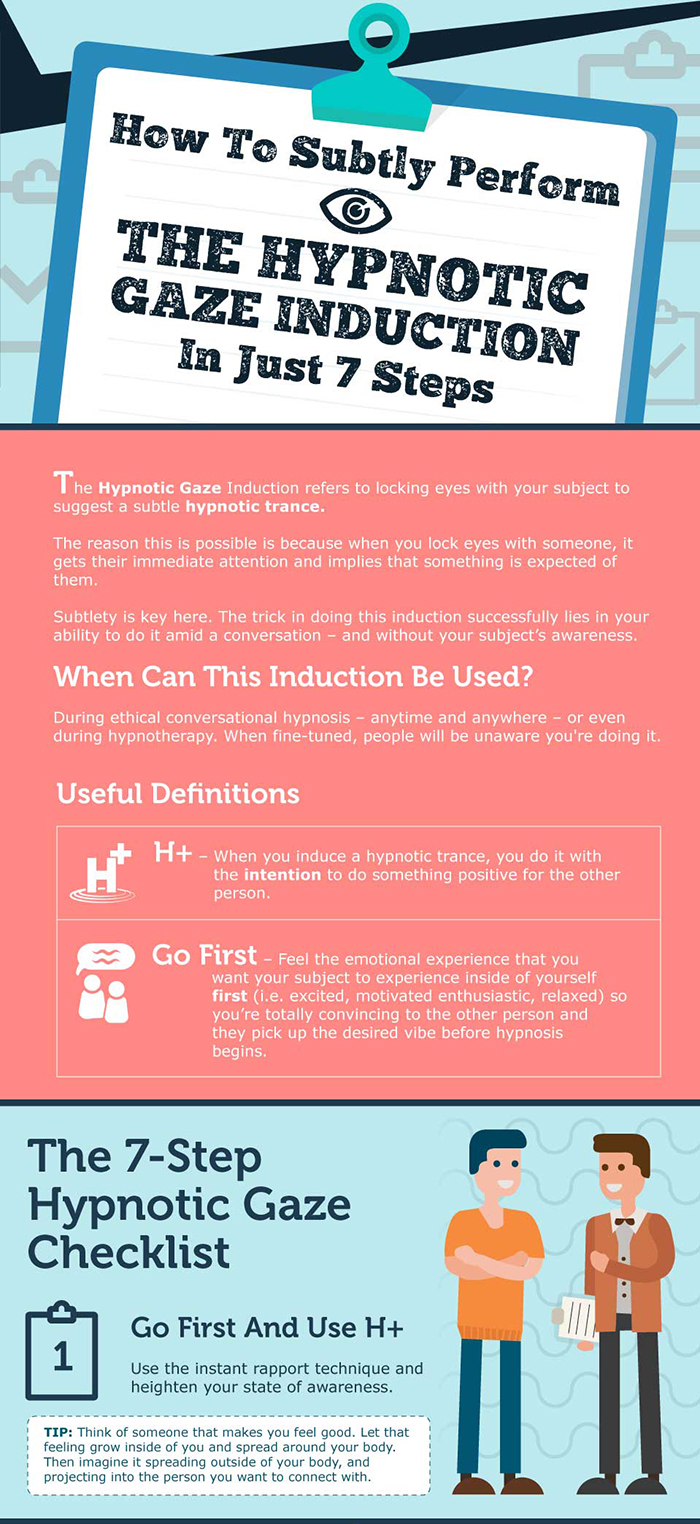
How To Subtly Perform The Hypnotic Gaze Induction In Just 7 Steps

How to perform the hypnotic gaze induction

As the art of hypnosis is a subtle, skillful practice that involves specific language, body language and unconscious sub-communication, the skilled hypnotist has many hypnosis techniques up their proverbial sleeves.

...the hypnotic gaze induction being one of them.

And as this type of hypnotic induction can be used in any situation, it's incredibly useful (not to mention, kinda cool) – meaning becoming well-versed in its finer intricacies is well worth your while.

Friday, June 24, 2016

How Does Hypnosis Work? The Science Behind Trance

How Does Hypnosis Work?

Ever asked yourself, how does hypnosis work? Discover the secrets behind it and the power of trance through this infographic. Also, learn everything about hypnotic experts and join Hypnosis Training Academy for hypnosis diploma.

Wednesday, June 15, 2016

7 Ways To Survive Your First (And Big) Hypnosis Failure

7 Ways To Survive Your First (And Big) Hypnosis Failure


Imagine the feeling.

You’re a professional hypnotist with a growing list of clients.

Every time you give a session, your confidence and enthusiasm grows.

You’re finding your feet in a big way, and it feels amazing to be able to use your skills to help people improve various aspects of their lives.

But then, just when everything seems to be going so well, you hit a brick wall.

A client comes along with an issue you know you can help them resolve. Maybe you’ve had success with the issue before, or maybe it’s just something you feel completely comfortable dealing with.

But try as you might, it just isn’t happening. No matter what you do, you can’t get them to respond. You can’t put them in a trance.

You can’t work your magic like you normally do. You’re failing, and your client lets you know it.

They come back for a second session, hoping things will improve, and all too eager to share their doubts and reservations with you.

What are you supposed to do now?

Here are some suggestions on how you can overcome hypnosis failure and gradually turn things around.

1. Take Client Feedback Seriously
 
Whatever your client tells you, they’re right.

If they tell you it hasn’t worked, then you have to accept that. But don’t just leave it at that and give in. There are plenty of things you can do to find out what went wrong.

The most important thing you can do is to listen to your client’s feedback. If things didn’t work the way they normally would, you need to find out why. One of the simplest ways to do that is by asking a few questions, such as:

Does the client have doubts about your abilities as a hypnotist?

Do they have doubts about hypnosis in general?

Do they really want to change?

Do they really want to be there?

It sometimes happens that people come to a hypnotist with the wrong kind of motivation. In some cases they turn up because they’ve been forced to go. Or perhaps they’ve tried everything else they can think of and they see hypnosis as their last hope.

There are lots of problems with these motives. If they’ve been forced to attend, then there’s no real desire on their part to change. They’re doing it to please other people, and just turning up means they’re holding up at least part of their side of the bargain.

Likewise, if they don’t really want to change, there’s nothing you can do to make them. They’ll be like a dog with a bone, and the more you try to tug that bone away, the tighter they hold on.

If you suspect either of these scenarios – which you can find out by asking them – then stop what you’re doing. Tell the client that they have no chance of success unless they personally want to change. Then ask them to come back when they’ve made up their mind and are certain they want to use hypnosis to resolve the issue.

This is also a good opportunity to prime the client in preparation for their next visit. Do that by giving them the following information:
  • The success you’ve had with other clients regarding this issue
  • How everyone is different and how they can respond to hypnosis in their own unique ways
  • How it can take longer to discover what works for some people than for others
The old adage is true: 

Tweet thisYou can’t help people who aren’t ready to help themselves.  

Give them the facts, state the reality of the situation, and invite them to return when they feel ready to take the next step.

2. Adapt Your Initial Approach
 
Of course, it isn’t a question of blame. It’s not the client’s fault and it’s not your fault. It’s more likely a combination of the two.

Being a professional, you won’t take it lying down. You won’t simply dismiss it as a bad experience and move on. You’ll take positive steps to make sure it doesn’t happen again.

Here are some ideas you can implement that will help you to do that:
  • Analyse your session. What techniques did you use? What other approaches could you take? Do you need to review the technique to make sure you’ve got it spot on?
  • Do some research. Get in touch with other hypnotists in your professional network. Pick their brains and find out how they might deal with a similar situation.
  • Ask for help. Visit forums and Facebook groups to chat with hypnotists and hypnotherapists about the issue.
Remember that whatever you’re going through, someone else has gone through it before you. So use this as an opportunity to discover as many possible options and approaches as you can.

Keep reading to know how to bounce back and survive your first big hypnosis failure as a professional hypnotherapist at Hypnosis Training Academy.