Friday, October 28, 2016

Amusing Milton Erickson Story – How To Influence Your Daughter’s New Boyfriend

Amusing Milton Erickson Story – How To Influence Your Daughter’s New Boyfriend

It’s often a nail-biting experience for a young man when meeting the father of his girlfriend for the very first time.

Well, there a probably a few more variables that could be thrown into the mix to make the story Igor shares in the video above even worse.

But when your girlfriend’s father happens to be Milton Erickson, and you’re a huge fan of his work, you can understand why this caused a storm of overwhelm to break loose in the young man’s nervous mind.

To hear this famous story and find out more about Erickson’s unique style, check the video out.
 
Not only will it shed some light on what made him so legendary… but you’ll also get a glimpse into his trickster nature.

Can’t get enough of Ericksonian hypnotic storytelling & metaphors?
You can get the entire Hypnotic Ericksonian Storytelling Metaphors Program here.


Saturday, October 22, 2016

How To Mine for Storytelling Metaphors: A Hypnotic Demonstration

How to Overcome Hypnosis Obstacle with Mine for Metaphor Technique

It’s a common default reaction when faced with a problem…

In your subject’s determined and well-meaning attempt to understand, analyze, assess and solve an issue, they unwittingly build it up.

The problem grows arms and legs – making it so much more intimidating than what it really is (or ought to be).

This is where overcoming a problem starts to feel impossible.

And is exactly the point where you need to get your subject to do a mental U-turn.

Because rather than building up a problem, the fastest and most powerful way to solve it is to actually scale it back to the core.

Interested to find out how?


Friday, October 14, 2016

How To Tell A Hypnotic Story That Heals & Transforms Your Subject

How To Tell A Hypnotic Story That Heals & Transforms Your Subject

When people think of Milton Erickson, one trait that comes to mind was his seemingly natural "gift" to tell deeply hypnotizing stories.

The way he could entrance his subjects with even the simplest of words is what gained him so much respect and admiration.

There’s no disputing that he was a clever man and a brilliant hypnotist.

But his ability to always find the right words had nothing to do with him being a Shakespearean-like wordsmith.

In fact, his words were secondary when it came to his proven formula.

Which was:

Hunt for the metaphor within your subject’s story.

Reason being: your subjects unknowingly tell you the stories that they need to hear so they can heal... they just don’t know it.

Meaning that your job as the hypnotist is to find this verbal elixir and feed it back to them.

This may sound like no easy feat. But actually, it’s a lot simpler than you might think.


Friday, October 7, 2016

The Hypnotist's Guide To Trance: What It Is, How You Can Induce It and 7 Signs That Show You It's Happening

The Hypnotist's Guide To Trance: What It Is, How You Can Induce It and 7 Signs That Show You It’s Happening

Many have wondered...

Is it some kind of mystical state of mind?

Is it a powerful force that puts you under a freaky spell where you have no control over your actions?

Is it a mysterious energy that elevates your brain to a higher plane of existence?

While the concept of hypnotic trance certainly conjures up a lot of intrigue and curiosity, the truth is a lot simpler.

In fact, significantly so.

"Trance" really is just a metaphor.

Yep, really.

We hope that this discovery didn’t just blow the air out of your tires in the same way that Dorothy’s first meeting with the Wizard of Oz did.

So let us explain...

Hypnotic "trance" is just a word that we use to identify the conditions under which someone responds to hypnotic suggestions.

We understand that this might read as a bit of a surprise to you. But the proof really is in the pudding. Academics have been studying trance for over a century now, trying to pinpoint exactly what it is.

Is it a state? Is it a trait? Is it a genetic predisposition?

But no matter how hard they look, they can’t find an answer.

They’ve even used fMRI scans that measure brain activity. But they found there was no detectable pattern in the brain when someone was in a trance.

what is trance brain scan

However, thankfully there’s a very good reason they came to this simple, yet obvious conclusion:

We’re in the trance state so often that it doesn’t show up in the brain as anything unusual. It’s an experience that occurs in everyone on a regular basis.

And to further compound this discovery, here is another little known fact:

You don’t need to be in a trance for hypnosis to occur. Hypnosis and trance are not synonymous.

Or otherwise put: being in a trance is not proof that any hypnotic experience is taking place.

However, what does go together like two peas in a pod is hypnosis and suggestion.

If you give someone a suggestion and they act on it, then it’s your gold litmus test that hypnosis is indeed working, meaning that hypnosis and suggestion are completely synonymous with one another.

After reading the above, understandably, you might be wondering, what’s the point of trance then?

So, let us explain...

Trance serves as a type of shorthand to let you know that the conditions in which someone responds to hypnotic suggestions are right.

Therefore, being able to identify a trance or the signs of trance can help you know when a hypnotic relationship has been established.

It gives you a green light to proceed with whatever hypnosis work you intend on doing.

That it’s an optimal time to cue up your suggestions.

Meaning that trance plays an incredibly important role in the whole hypnosis process.

In this article, we’re going to explain what this role is, in addition to explaining the following essential concepts so you’re able to confidently put your subjects into a trance...


So let’s jump in and get started...

Friday, September 16, 2016

[ADVANCED GUIDE] How To Master Hypnotic Regression Therapy – Part II: Proven 12 Step Method To Successfully Dissolve Anxiety, Phobias and Traumas, Plus Bonus Video Training

Master Regression Therapy – 12 Step Method To Successfully Dissolve Anxiety, Phobias and Traumas
Welcome to Part 2 of our comprehensive guide on regression hypnotherapy.

In this article, the 12-step regression method, which is taught worldwide at our hypnosis training seminars, will be broken down step-by-step.

After the technique breakdown, we’ve included a real-life demonstration of master hypnotist Igor Ledochowski doing regression therapy (using this exact method) to remove a woman’s fear of snakes, which had been terrifying her for 30 years.

Then, we’ll show you how to put the same technique into practice again – except this time conversationally – and in just a few minutes, too.

If, however, you’ve landed on this page having bypassed the essential principles and best practices covered in Part 1, we do urge you to take a step back and read the first article in this 2-part series.

Reason being: regression therapy is a very big topic. One where you’re dealing with someone’s (often intense) emotions and the way that person make sense of the world.

Therefore, this 12-step method will only be effective once you have an understanding of the dynamics behind regression therapy, which is covered in Part 1.

If, however you’re ready to proceed…

A FEW FINAL NOTES:

  • In the below example, the client is often referred to as the “adult” and “child.” This is based on the assumption that the memory or emotional trauma you’re trying to dissolve happened in their childhood (so you’re bouncing back and forth between adulthood and childhood), however, of course this may not be always the case.
  • As you work through each of the steps, which can be done very quickly once you become familiar with them, it’s important to continually give praise and encouragement to your client. Tell them they’re doing great, build up their self-confidence, comment on how well they’re handling it, and generally keep boosting their self-belief at every opportunity you get!
And for ease of use when reading this article, the links from each section are below:

  • The 12 Steps Of Regression Therapy

Do you want to become an Elite-Level Hypnotist? Join Igor’s upcoming webinar to find out what his 5 keys to success are and how to use them in your practice.
 

Wednesday, September 14, 2016

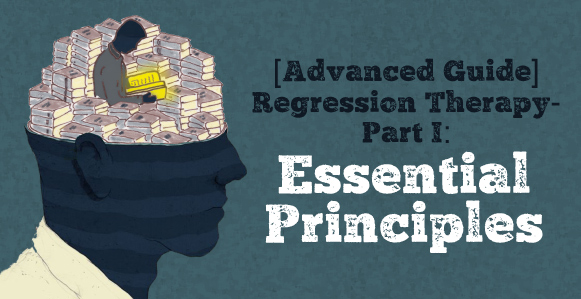
[ADVANCED GUIDE] How To Master Hypnotic Regression Therapy – Part I: Essential Principles To Profoundly Transform Your Subject’s Emotional Trauma

How To Master Hypnotic Regression Therapy - Part I

Warning! This 2-part series on regression hypnotherapy contains intermediate to advanced content that will make you a powerful force for good Hypnosis Power in the world.

So if you’re looking to for a comprehensive guide on regression hypnotherapy to enhance your existing hypnosis knowledge, you’ve come to the right place.

For ease of use, this guide is divided into two parts.

Part 1 dives straight into the essential principles and best practices that you need to be aware of before doing any regression work.

And in Part 2 the 12-step regression hypnotherapy method, which is taught by the Hypnosis Training Academy, is broken down, step-by-step.

And to show you how to piece it all together, in Part 2 there is also a bonus training video of master hypnotist Igor Ledochowski performing this powerful regression hypnotherapy method on a woman with a serious snake phobia.

To view the individual sections of Part 1, click on the links below (or continue reading):
And once you’ve gone through the essential principles covered in this article, you can access Part 2 here: [ADVANCED GUIDE] How To Master Hypnotic Regression Therapy – Part II: Proven 12 Step Method To Successfully Dissolve Anxiety, Phobias and Traumas, Plus Bonus Video Training

But first…

Before You Get Started…

Regression is a huge topic.

Given this, it’s impossible to condense all of the relevant information into the space of two articles.

This is why we’ll be focusing on the main underlying principles so you can use this information to enhance your existing knowledge.

Therefore, to understand this article completely and comprehensively, it is recommended that your hypnosis knowledge is of an advanced level.

The other thing you need to keep in mind is this:

Any trauma, phobia or situation where strong emotions exist can be debilitating.

It can make people suffer.

When using hypnotherapy, you’re trying to end that suffering. You’re trying to show people that they don’t need to suffer. That there is another way.

That they’re using their mental landscape in a way that’s causing them to suffer, so if they can change the way that mental landscape operates, they’ll stop the suffering.

Regression therapy for emotional trauma


Sometimes you can achieve that in 5 minutes. But sometimes it can take a lot longer.

The trick is not to get hung up on the steps involved in regression therapy but to focus on what you’re trying to accomplish.

As you’ll discover in Part 2, the 12 steps simply give you the framework to learn the process.

Once you know the process well enough, you can adapt it to fit the person and the situation. Keep reading>>
 

>>What are the 5 Keys to Becoming an Elite-Level Hypnotist? Sign up for this complimentary Masterclass followed by Q&A Session with Master Hypnotist, Igor Ledochowski.

Wednesday, July 20, 2016

How To Seamlessly Break Down Someone’s Resistance During Hypnosis With The Non-Awareness Set

breakdown resistance during hypnotherapy
What’s the point of hypnosis?

If you said to help people, you’d be right. That’s the ultimate goal. To be a force for good in the world. No arguments there.

However, there’s a problem. Because, as a hypnotist, you can only help people if you’re able to hypnotize them. While that statement seems a little contradictory, it’s not. And here’s why.

If you want to hypnotize someone, you have to put them into a trance. You have to bypass their conscious critical mind.

You have to make contact with their unconscious mind, because that’s where the power to make change resides. And the only way you can do that is by breaking down their resistance.

That’s a particularly useful skill to have with certain kinds of people – people who think things through too much, or perhaps who’ve never been hypnotized before. Reason being, in these types of cases, you may encounter more resistance, at least during the initial phases.

As a hypnotist, you might already know lots of techniques you can use to break down someone’s resistance.

But, they take time. Ideally you need something that’s fast, reliable, effective and easy to use. Something that fits into the 4-stage hypnosis protocol like a glove.

Something like the Non-Awareness Set.

5 Things You Need To Know About Mastering The Non-Awareness Set

The Non-Awareness Set is a technique created by hypnosis pioneer Dr. Milton Erickson. Check out the points below so you can master it just like the late and great Erickson did:


We’ll take a detailed look at all 4 components that make up the Non-Awareness Set shortly. But first, what’s the point of using it in the first place?

keep reading to why is the non-awareness set so effective when it comes to breaking down resistance in hypnosis? Learn from hypnosis experts about the 4 basic components in the Non-Awareness set, their benefits, the right time to put that into the practice.